

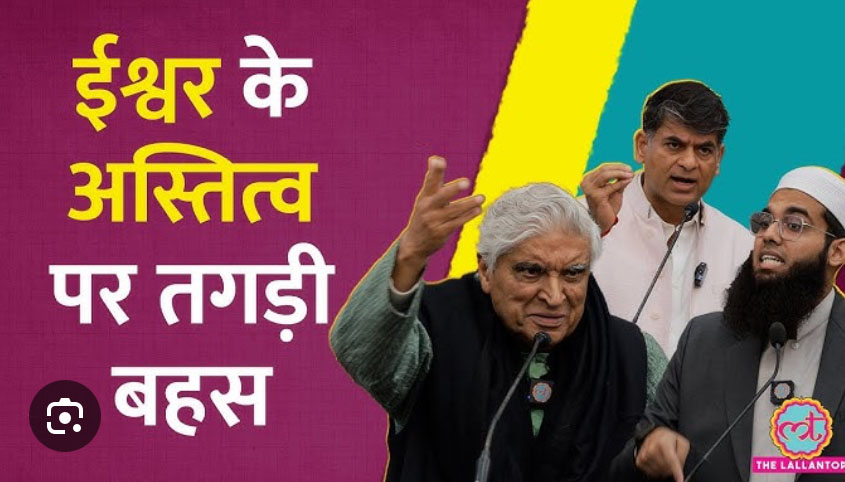
The dialogue between Javed Akhtar and Mufti Shamail Nadwi did not resolve the question of whether God exists—and perhaps that was never its true purpose. What it did achieve was the reopening of a public space for disagreement without hostility, for listening without immediate judgment. In a time increasingly shaped by certainty and polarization, this itself is a meaningful contribution.
Javed Akhtar reminded the audience that belief, if it is to matter, must engage honestly with human suffering and moral responsibility. Mufti Shamail Nadwi offered a different perspective, suggesting that reason and faith need not be seen as opposites, and that metaphysical explanations may coexist with rational inquiry. Together, the dialogue demonstrated that the search for truth is less about arriving at final answers and more about sustaining thoughtful conversation.
Empathy as a Measure of Belief
One aspect of the discussion that left a strong impression was Javed Akhtar’s response to human suffering, particularly his concern for children affected by conflict. His reaction was direct, emotional, and grounded in universal human empathy. It highlighted an important point: moral sensitivity does not depend on religious belief.
Mufti Shamail Nadwi approached the same issue from a theological perspective, emphasizing human limitations in understanding divine will and the broader context of events. While this approach is rooted in long-standing religious traditions, it also raised important questions for listeners: how do we balance faith-based explanations with immediate human compassion? At what point should moral clarity stand independent of theology?
These are not easy questions, and they deserve careful, respectful consideration rather than quick judgments.
Belief, Practice, and Human Outcome
It is important to clarify that questioning a particular argument does not amount to rejecting religion or faith. Many believers—including practitioners of yoga, meditation, and spiritual disciplines—understand God not as an ideological position but as a path toward becoming more compassionate, disciplined, and humane.
From this perspective, belief systems are meaningful only insofar as they help shape better human beings. If an atheist’s worldview leads to kindness, responsibility, and empathy, it deserves respect. Likewise, if religious faith cultivates humility, care for others, and moral courage, it plays a valuable role in society.
The concern arises when belief—of any kind—becomes disconnected from these outcomes. When ideology begins to overshadow empathy, it calls for reflection rather than defense.
A Thoughtful Question Worth Considering
One of Javed Akhtar’s observations invited deeper thought: if the existence of God were conclusively proven, what practical changes would follow? Would humanity necessarily become more ethical and compassionate, or would existing divisions simply take new forms?
History offers mixed answers. While faith has inspired great acts of kindness and creativity, it has also been used to justify conflict. This suggests that certainty alone—religious or secular—does not automatically lead to moral progress. Often, humility and self-questioning play a more constructive role.
On Platforms and Public Discourse
The dialogue also raises questions about how such conversations are framed and presented. Why this pairing? Why this format? And why are complex philosophical exchanges often reduced to narratives of winning and losing?
Public platforms carry influence, and with it, responsibility. When discussions about belief and disbelief are presented as contests, there is a risk that nuance is lost and deeper reflection gives way to spectacle. Perhaps there is equal value in conversations that explore shared human concerns—ethics, compassion, coexistence—without positioning opposing worldviews as adversaries.
Humanity Before Ideology
This reflection is not an argument against religion, nor against any particular faith tradition. It is a call to place humanity at the center of our intellectual and spiritual engagements.
Belief should be measured not by the certainty of its claims, but by the quality of its outcomes. If a worldview—religious or secular—encourages empathy, responsibility, and care for the vulnerable, it serves society well. If it distances us from human suffering or makes moral judgment conditional, it invites re-examination.
The dialogue between Javed Akhtar and Mufti Shamail Nadwi reminded us that disagreement need not be hostile, and that difficult questions can be discussed publicly with dignity. At the same time, it highlighted the need for conversations that go beyond intellectual positioning and return repeatedly to the human consequences of our beliefs.
Perhaps the most meaningful discussions are not those that ask who is right, but those that ask how we can live together with greater compassion, honesty, and humility.
In the end, whether one believes in God or not, the shared responsibility remains the same: to reduce suffering, to cultivate understanding, and to remain open to learning from one another.